Accessible content


 Contact us!

 Contact us!
News
Through body and word: two healing performances and a discussion on the integration of third-country nationals in Latvia
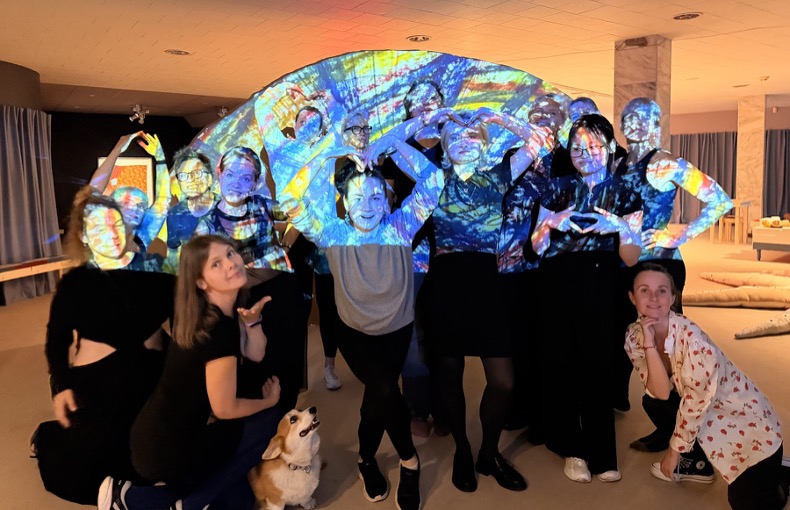
On 5 September 2026, at the Riga Congress Hall, as part of the International Contemporary Art Festival Survival Kit 17, the performances “Appendix – a Cut into the Side Currents” and “I Speak” took place, followed by a panel discussion on migration, integration, and the nuances of belonging — or, conversely, not belonging — for foreign nationals in present-day Latvia. More than 80 spectators gathered for the two performances and the discussion. Some of them took part in the performances themselves and in the discussion, adding their own experience and questions to the panel.
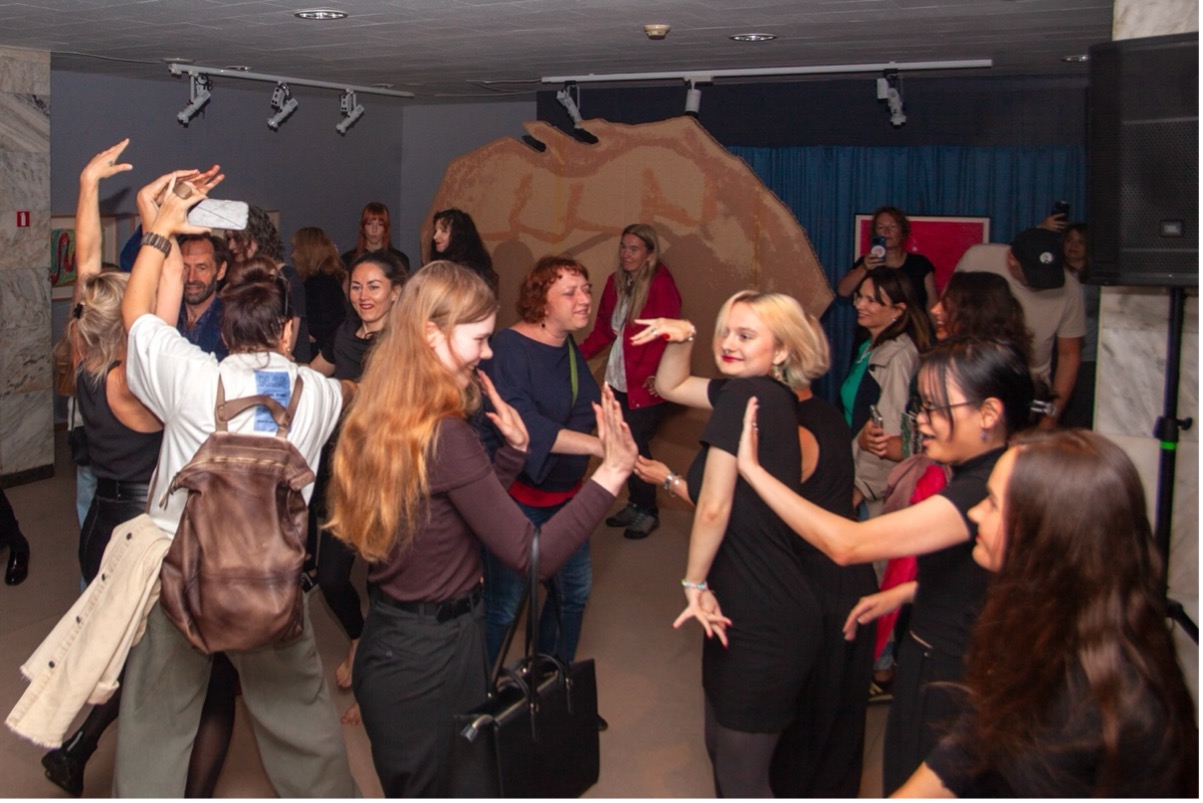
At the close of the “Appendix” performance, the participants invited the audience to join in a shared movement. Photo: Georgs Kreislers
Appendix: four months of networks, shared experience and exchanged energy
The evening opened with a performance by “Appendix,” a movement group bringing together Latvian and third-country nationals, led by trainer and artist Viktorija Fomenko. The performance was built on testimony and a message about a four-month process of building solidarity: once a week, in a co-creation space set up in the centre of Riga, women of different generations and life paths — from Belarus, India, Israel, Kazakhstan, Russia, Latvia, Lithuania, Ukraine, Uzbekistan and Vietnam — gathered to take part together in inclusive fitness training sessions conducted in Latvian. Through the body, language, memories and everyday experience, the participants created a space for meeting and exchanging information, and for talking about life and everyday coexistence in Latvia, with the aim of reducing stereotypes and overcoming the difficulties of inclusion alongside different accents and levels of language learning. On the evening of the event, this practice became a public demonstration — dance, energy, music and language.
“The movement group’s evenings, which brought together women of different nationalities, ages and professions and invited them to spend time together exercising, turned out to be a powerful encouragement to start speaking Latvian, even though their previous experience of using the language had been very limited. It is precisely movement that gradually sets language use and application into motion in everyday life!”
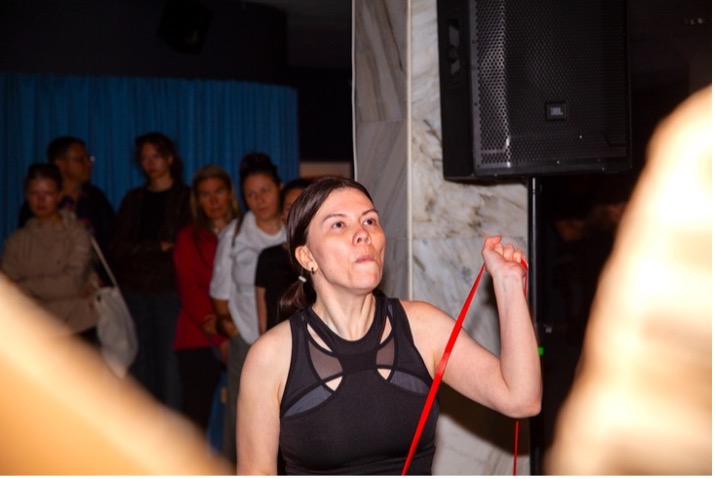
Sofia Melnykova’s solo performance. Photo: Georgs Kreislers
Sofia Melnykova: when what fits everyone doesn’t fit one
If “Appendix” spoke about togetherness and inclusion, the solo performance of project participant, Ukrainian director Sofia Melnykova, turned to the opposite process, portraying her own experience of not fitting into a systemic and, to some extent, unified process. Using a red rubber band that turned from an exercise tool into a strangling device during the performance, and exercise-like movements that gradually developed into tense, physically intense self-torment, Sofia visualised her experience of an impossible integration into a community denoted by the shared term “third-country nationals.” The message of the performance was unambiguous: the experience of Ukrainian war refugees is not, and must not be, made the same as the experience of other third-country nationals. Their route to Latvia, legal status and everyday challenges differ, and by lumping everyone into one “pot,” essential nuances disappear — for example, the fact that Ukrainian and Russian citizens, who both fall under the category of third-country nationals, cannot perform on the same stage. The performance “I Speak” also raised the question of language: the Ukrainian refugee’s insufficient knowledge of Latvian, which has not improved over several years now, and her own practised everyday communication in Russian — the only language in which she is able to converse, even though she does not wish to.
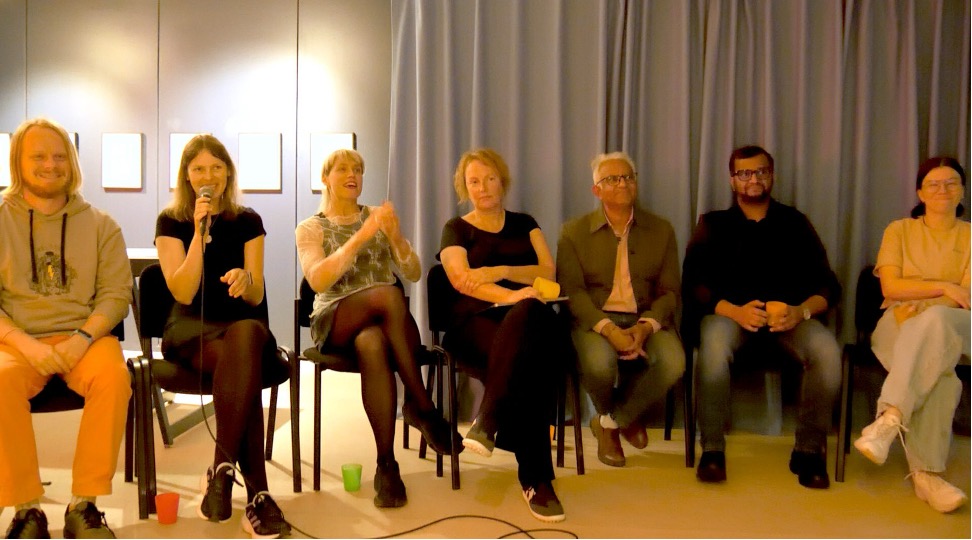
Discussion participants and moderator Kristīne Briede. Photo: Gundega Anna Antonio
The discussion: Belarusians, Indians, a Ukrainian, a Latvian and a Russian speak
Both performances were followed by a panel discussion, led by Kristīne Briede, director and communications manager of the project “Appendix – a Cut into the Side Currents.” To share their experience of integration in Latvia, one microphone brought together Ukrainian director Sofia Melnykova; Indian film-distribution business owner Abu Sohail Ur Rehman; Latvian citizens Sundars Vaidesvarans, a university lecturer, and Viktorija Fomenko, a jewellery artist and fitness trainer; as well as IT-sector representatives Maryia Danko and Mikalai Yankoits from Belarus. The discussion was held in Latvian, with participants helping one another in English at moments when words were lacking.
The discussion addressed both the difficulties and obstacles that third-country nationals encounter in their everyday life in Latvia, and the concrete achievements and paths that could improve processes of inclusion into society. Participants also spoke about current political developments directly affecting newcomers to Latvia, as well as the role of the media in this process and the stereotypes newcomers have to face. The audience, including the “host side” — Latvians — was active and took part in the discussion with their own additions and questions. A recording of the discussion will be available to listen to and watch at https://lcca.lv/lv/appendix—iegrieziens-blakusslanos/ starting from 29 September 2026.https://lcca.lv/lv/appendix—iegrieziens-blakusslanos/
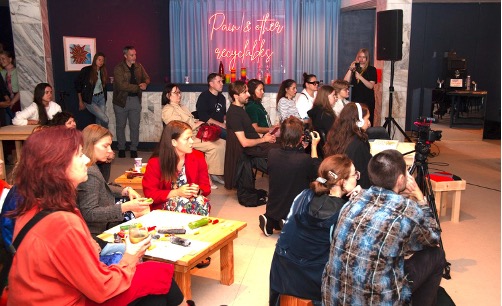
The audience. Photo: Georgs Kreislers
The evening showed that one project and one story will not be enough
Both performances, the discussion that followed them, and the interest shown by the host society in the event once again confirmed that the path of social integration is difficult, challenging and multi-layered — and that the processes which began with the restoration of Latvia’s independence three decades ago have fundamentally changed in character. It would, of course, be simpler to give up and allow the segregation of different, ever-growing communities to develop. But “Appendix – a Cut into the Side Currents” will continue its work with new activities, which we invite you to follow. With art as a healing arrow of wind, leading the way!
ABOUT THE PROJECT
The performance and discussion “Appendix – a Cut into the Side Currents” took place within the International Contemporary Art Festival Survival Kit 17 (27.08.–27.09.2026, Riga Congress Hall), under its cross-cutting theme “Arrow of Wind: On Art and Healing.” The festival, organised since 2009 by the Latvian Centre for Contemporary Art (LCCA), is curated by Elena Sorokina and Simona Markele Dvoraka in cooperation with the “Radical Care Practices and Visions Initiative.”
The project “Appendix – a Cut into the Side Currents” is implemented by the Latvian Centre for Contemporary Art with the support of the Asylum, Migration and Integration Fund (AMIF) (Specific Objective No. 2 “Legal migration and integration,” Activity No. 13.3 “Integration measures for third-country nationals promoting the inclusion of the target group into society”). The lead authority in Latvia is the Ministry of the Interior; the authority delegated on integration matters is the Ministry of Culture. Grant agreement No. PMIF/13.3./2025/1/05. Total project funding — EUR 99,999.76 (75% AMIF funding, 25% co-financing from the state budget).
More about the project: lcca.lv/lv/appendix—iegrieziens-blakusslanos · Instagram: instagram.com/appendix_project_2026