Accessible content


 Contact us!

 Contact us!
News
Women from ten countries in the Survival Kit 17 programme
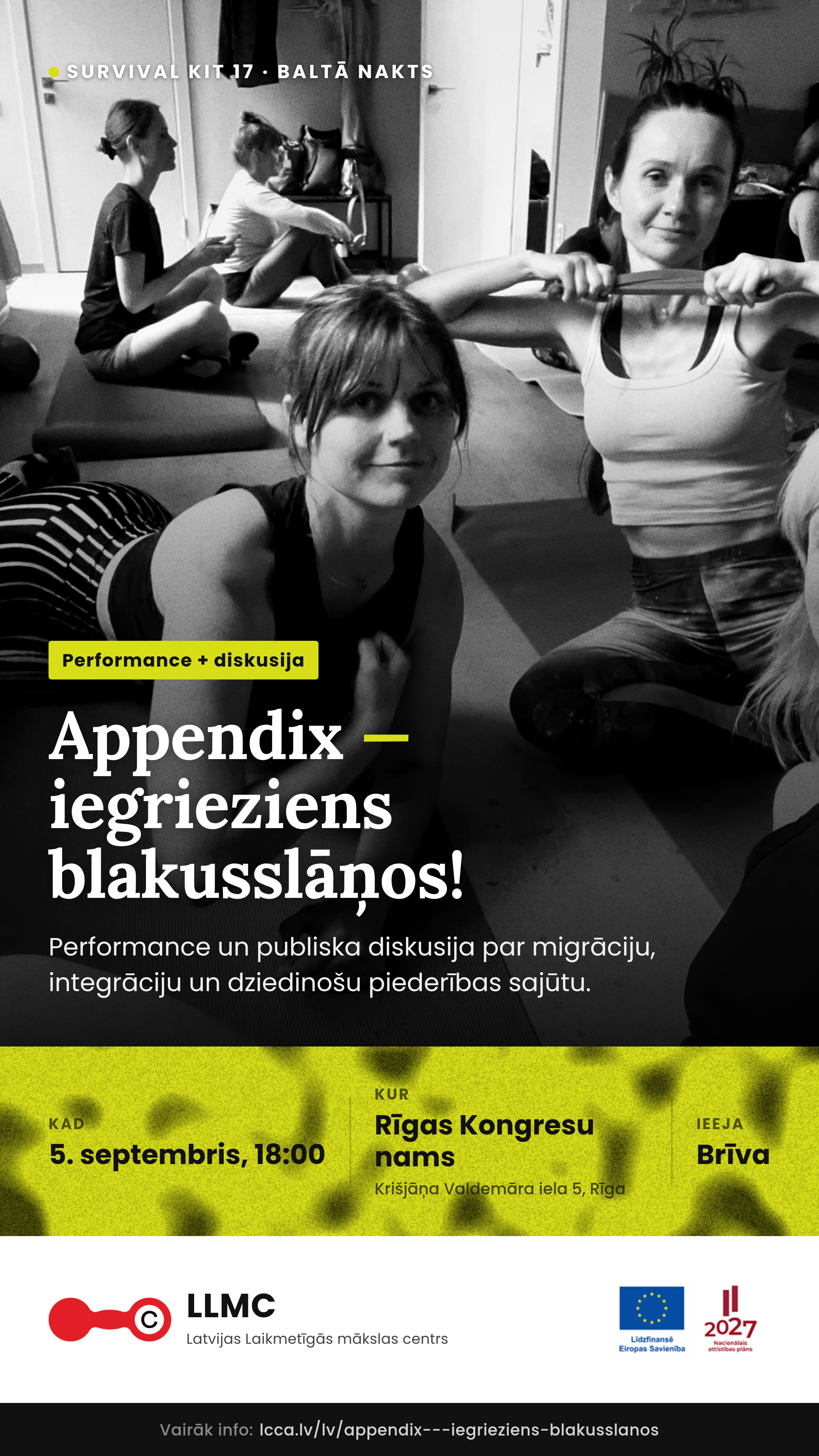
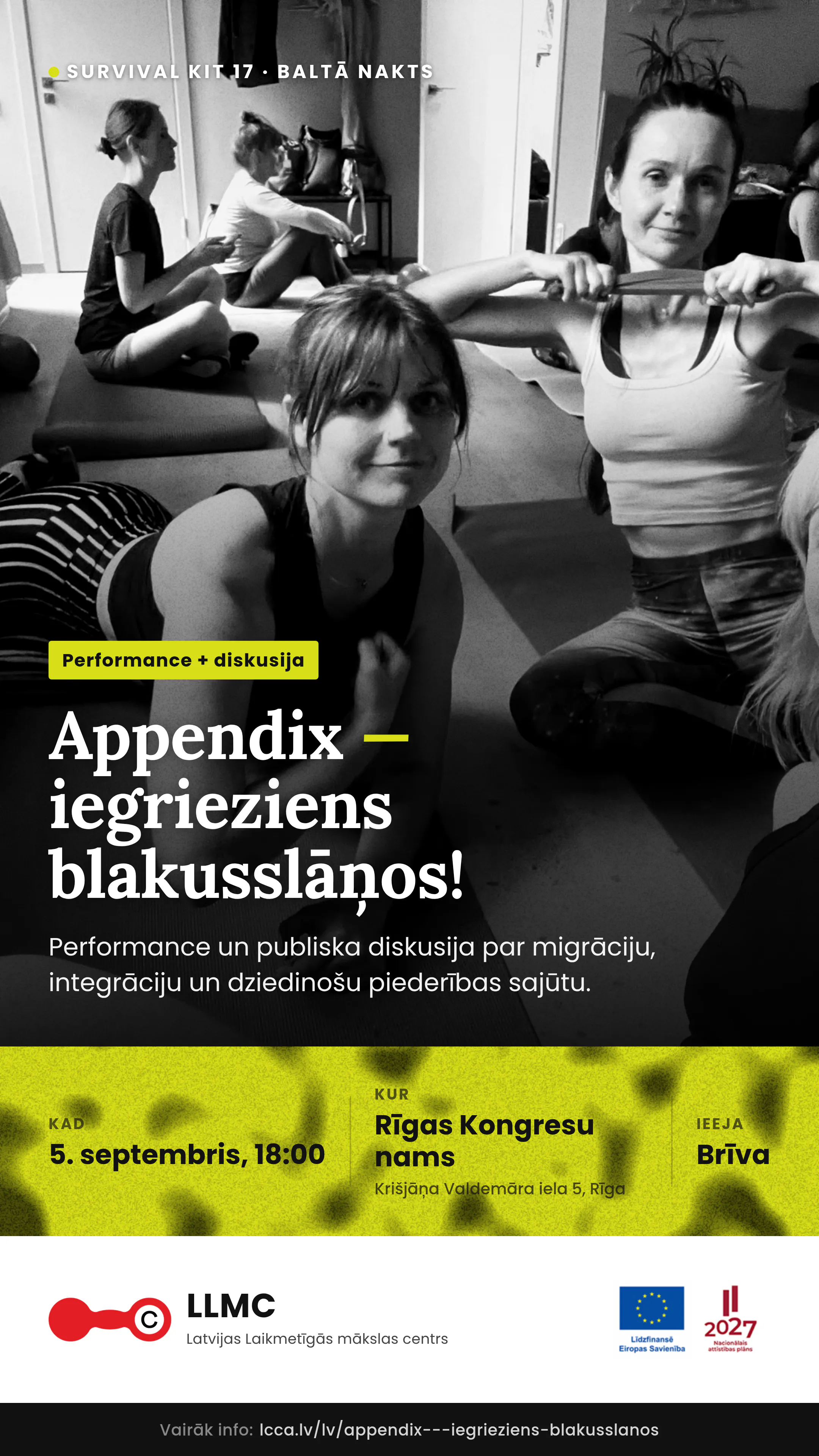
A performance and discussion on coexistence in Latvian society
On September 5th, the Riga Congress Centre will host the performance “Appendix – Side Currents” and a public discussion on migration, integration and belonging in contemporary Latvia, held within Survival Kit 17’s cross-cutting theme “Wind Arrow: On Art and Healing.”
On Friday, September 5th, at 18:00, the Riga Congress Centre will host the performance and public discussion “Appendix – a Cut into Side Currents”), part of the programme of the International Contemporary Art Festival Survival Kit 17. The event will open with a performance by “Appendix,” a joint movement group of Latvian and third-country citizens, followed by an open conversation with people who have integrated into Latvian society from India, Belarus and Ukraine, on migration, integration, security, language, stereotypes and community-building.
The performance is the result of a four-month process: once a week, women of different generations and life paths from Belarus, India, Israel, Kazakhstan, Russia, Latvia, Lithuania, Ukraine, Uzbekistan and Vietnam gathered in a co-creation space in central Riga to take part in integrative fitness training led by movement coach and artist Viktorija Fomenko. Through the body and language, memories, everyday experience and hopes for the future, the participants created a symbolic and physical space of encounter, in which stereotypes, fears and the difficulties of inclusion gradually attempted to transform into shared material and living communication.
This year, Survival Kit 17’s cross-cutting theme “Wind Arrow: On Art and Healing” explores the shared territory of art and healing — from therapy and ritual to physical and spiritual wellbeing. “Appendix” shifts this vector of healing from the individual to the collective level: a shared, sustained bodily and spiritual practice as a process in which what needs healing is not individual people, but a rift in the fabric of contemporary society — distrust, alienation, society’s rejection of “newcomers” regardless of the circumstances that brought them here, and the frequent lumping of everyone into “one pot.” Physical training and sweat shed together become a metaphor here, and a sustained process for which administrative solutions alone are not enough.
The performance and discussion take place at a time when, as both immigration to Latvia and emigration from it are rising simultaneously, society is polarising and the topic of integration is taking on an increasingly significant and emotional role. This year the Saeima reviewed the final report of the parliamentary inquiry commission on problems in immigration regulation, which includes more than 100 recommendations, while independent media fact-checks have this year pointed out that public claims linking third-country nationals to crime often do not hold up against real, population-adjusted data. “Appendix” offers an alternative way of thinking about these questions, through contemporary art, movement, and networking with people who have arrived in Latvia in recent years.
The performance will be followed by a public discussion featuring people who have successfully integrated into Latvia from India, Belarus and Ukraine, along with other participants. The conversation will address different paths to inclusion and the forming — or not forming — of a sense of belonging; the host society’s attitude toward newcomers and the problems that arise in the integration process when people whose countries are at war are forced to share a space within the same group of newcomers; and the role of media and social networks in shaping the discourse on migration and integration — how news headlines, isolated data points and political statements shape public perceptions of newcomers, and what responsibility journalists bear in discussing these issues. At the centre of the conversation are questions currently active in public debate: migration, integration, security, language, stereotypes, community-building, rejection and media responsibility. The discussion will be moderated by Kristīne Briede. The conversation will be held in Latvian; interpretation from English will be provided if needed.
“The movement group’s evenings, which brought together women of different nationalities, ages and professions and invited them to spend time together exercising, turned out to be a powerful encouragement to start speaking Latvian, even though prior experience using the Latvian language had been very limited. It’s movement itself that gradually sets language use and everyday application in motion!”
— Līga Puriņa-Purīte, project leader of “Appendix – a Cut into Side Currents”
EVENT AT A GLANCE
WHAT | Performance and discussion “Appendix – a Cut into Side Currents” |
WHEN | September 5th, 2026, at 18:00 |
WHERE | International Contemporary Art Festival Survival Kit 17, Kongresu nams, Krišjāņa Valdemāra iela 5, Riga |
LANGUAGE | Latvian (with the help of translator if necessary) |
ADMISSION | Free, as part of White Night (Baltā nakts) |
DISCUSSION MODERATOR |
Kristīne Briede |
MOVEMENT GROUP LEADER |
Viktorija Fomenko |
ABOUT THE PROJECT
The performance and discussion take place within the project “Appendix – a Cut into Side Currents,” carried out by the Latvian Centre for Contemporary Art (LCCA). The project is implemented with the financial support of the Asylum, Migration and Integration Fund, under specific objective No. 2 “Legal migration and integration,” activity No. 13.3 “Third-country nationals’ integration measures that promote the target group’s inclusion in society,” “Activities providing an innovative approach to promoting integration processes.” The lead authority in Latvia is the Ministry of the Interior, and the delegated authority for integration matters is the Ministry of Culture. Grant agreement No. PMIF/13.3./2025/1/05. The total project funding is EUR 99,999.76, comprising Asylum, Migration and Integration Fund funding for the 2021–2027 period at 75%, and state budget co-financing at 25%.
ABOUT SURVIVAL KIT 17
Survival Kit is an annual International Contemporary Art Festival, organised since 2009 by the Latvian Centre for Contemporary Art (LCCA). This year’s edition — Survival Kit 17 — runs from August 27th to September 27th at the Riga Congress Centre, under the title “Wind Arrow: On Art and Healing.” The festival is curated by Elena Sorokina and Simona Marķele Dvoraka, in cooperation with the Radical Care Practices and Visions Initiative, and explores the shared territory of art and healing through performances, conversations, exhibitions and guided walks — a territory into which “Appendix” brings a collective, intercultural dimension of healing.
MEDIA CONTACTS
Project manager: Līga Puriņa-Purīte, [email protected]
Project communications manager: Kristīne Briede, [email protected]